Weather Alert in Iowa
Winter Storm Watch issued March 13 at 9:31PM CDT until March 16 at 1:00PM CDT by NWS La Crosse WI
AREAS AFFECTED: Floyd; Chickasaw; Fayette; Clayton; Grant
DESCRIPTION: ...MAJOR WINTER STORM SATURDAY NIGHT INTO MONDAY MORNING... .A prolonged, high-impact winter storm will impact the region from Saturday night through Monday morning. Highest snow totals in excess of 12 to 18 inches are favored north of Interstate 90 with some locales north of Highway 10 approaching 24 inches. Along Interstate 90, a wintry mix of snow, freezing rain, and sleet makes it difficult to pin down exact snow and ice amounts, but impacts are warranting of a winter storm warning. Across northeast Iowa and southwest Wisconsin, snow does not look to arrive until Sunday afternoon, so the winter storm watch is maintained until further details can be ascertained. Increasing winds Sunday afternoon and night should result in whiteout conditions for exposed locales and an upgrade to a blizzard warning is likely once the exact threat area is determined. Regardless of exact snow amounts, expect major travel impacts regionwide with some roads possibly impassable, especially in wind-prone areas. * WHAT...Heavy snow possible. Total snow accumulations between 3 and 6 inches possible. Winds could gust as high as 55 mph and may result in blizzard conditions later Sunday into Monday morning. * WHERE...In Iowa, Floyd, Chickasaw, Clayton, and Fayette Counties. In Wisconsin, Grant County. * WHEN...From Sunday afternoon through Monday afternoon. * IMPACTS...Travel could be very difficult to impossible. Widespread blowing snow could significantly reduce visibility. The hazardous conditions could impact the Monday morning commute. Gusty winds could bring down tree branches, especially those coated in ice.
INSTRUCTION: Monitor the latest forecasts for updates on this situation.
Want more detail? Get the Complete 7 Day and Night Detailed Forecast!
Current U.S. National Radar--Current
The Current National Weather Radar is shown below with a UTC Time (subtract 5 hours from UTC to get Eastern Time).

National Weather Forecast--Current
The Current National Weather Forecast and National Weather Map are shown below.

National Weather Forecast for Tomorrow
Tomorrow National Weather Forecast and Tomorrow National Weather Map are show below.

North America Water Vapor (Moisture)
This map shows recent moisture content over North America. Bright and colored areas show high moisture (ie, clouds); brown indicates very little moisture present; black indicates no moisture.

Weather Topic: What are Stratus Clouds?
Home - Education - Cloud Types - Stratus Clouds
 Next Topic: Wall Clouds
Stratus clouds are similar to altostratus clouds, but form at a
lower altitude and are identified by their fog-like appearance, lacking the
distinguishing features of most clouds.
Stratus clouds are wider than most clouds, and their base has a smooth, uniform
look which is lighter in color than a nimbostratus cloud.
The presence of a stratus cloud indicates the possibility of minor precipitation,
such as drizzle, but heavier precipitation does not typically arrive in the form
of a stratus cloud.
Next Topic: Wall Clouds
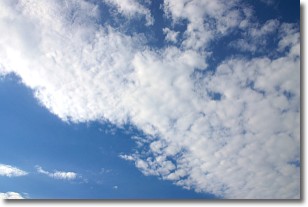
Weather Topic: What are Altocumulus Clouds?
Home - Education - Cloud Types - Altocumulus Clouds
 Next Topic: Altostratus Clouds
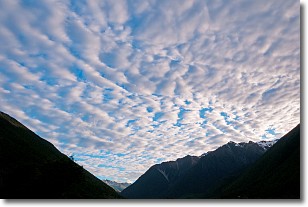
Similar to cirrocumulus clouds, altocumulus clouds are
characterized by cloud patches. They are distinguished by larger cloudlets
than cirrocumulus clouds but are still smaller than stratocumulus clouds.
Altocumulus clouds most commonly form in middle altitudes (between 2 and 5 km)
and may resemble, at times, the shape of a flying saucer.
These uncommon formations, called altocumulus lenticularis, are created by uplift
in the atmosphere and are most often seen in close proximity to mountains.
Next Topic: Altostratus Clouds
Current conditions powered by WeatherAPI.com