Weather Alert in Washington
Flood Warning issued March 20 at 12:37PM PDT until March 22 at 12:45AM PDT by NWS Seattle WA
AREAS AFFECTED: Snohomish, WA
DESCRIPTION: ...The Flood Warning continues for the following rivers in Washington... Snohomish River Near Monroe affecting Snohomish County. .Rain continues, though is beginning to taper off in the Central Cascades. * WHAT...Moderate flooding is occurring and major flooding is forecast. * WHERE...Snohomish River near Monroe. * WHEN...Until early Sunday morning. * IMPACTS...At 17.0 feet, the Snohomish River will cause major flooding...inundating farm land...roads...and some residential areas. Levees will likely suffer damage. Flooding will occur all along the river including headwaters...tributaries...and other streams within and near the Snohomish River Basin. A stage of 17 feet at this location corresponds to Phase 2 in the Snohomish County Flood Warning System. * ADDITIONAL DETAILS... - At 12:15 PM PDT Friday the stage was 16.7 feet. - Flood stage is 15.0 feet. - Recent Activity...The maximum river stage in the 24 hours ending at 12:15 PM PDT Friday was 16.7 feet. - Forecast...The river is expected to rise to a crest of 18.3 feet late this evening. It will then fall below flood stage early tomorrow afternoon. - Flood History...This crest compares to a previous crest of 18.0 feet on 02/16/1982. - http://www.weather.gov/safety/flood
INSTRUCTION: Motorists should not attempt to drive around barricades or drive cars through flooded areas. Be especially cautious at night when it is harder to recognize the dangers of flooding. Turn around, don't drown when encountering flooded roads. Most flood deaths occur in vehicles. Additional information is available at www.weather.gov. The next statement will be issued by this evening at 845 PM PDT.
Want more detail? Get the Complete 7 Day and Night Detailed Forecast!
Current U.S. National Radar--Current
The Current National Weather Radar is shown below with a UTC Time (subtract 5 hours from UTC to get Eastern Time).

National Weather Forecast--Current
The Current National Weather Forecast and National Weather Map are shown below.

National Weather Forecast for Tomorrow
Tomorrow National Weather Forecast and Tomorrow National Weather Map are show below.

North America Water Vapor (Moisture)
This map shows recent moisture content over North America. Bright and colored areas show high moisture (ie, clouds); brown indicates very little moisture present; black indicates no moisture.

Weather Topic: What are Stratus Clouds?
Home - Education - Cloud Types - Stratus Clouds
 Next Topic: Wall Clouds
Stratus clouds are similar to altostratus clouds, but form at a
lower altitude and are identified by their fog-like appearance, lacking the
distinguishing features of most clouds.
Stratus clouds are wider than most clouds, and their base has a smooth, uniform
look which is lighter in color than a nimbostratus cloud.
The presence of a stratus cloud indicates the possibility of minor precipitation,
such as drizzle, but heavier precipitation does not typically arrive in the form
of a stratus cloud.
Next Topic: Wall Clouds
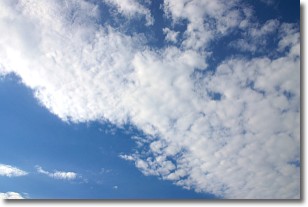
Weather Topic: What are Altocumulus Clouds?
Home - Education - Cloud Types - Altocumulus Clouds
 Next Topic: Altostratus Clouds
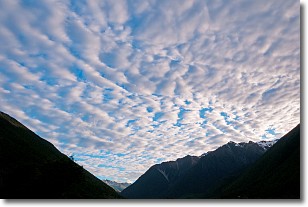
Similar to cirrocumulus clouds, altocumulus clouds are
characterized by cloud patches. They are distinguished by larger cloudlets
than cirrocumulus clouds but are still smaller than stratocumulus clouds.
Altocumulus clouds most commonly form in middle altitudes (between 2 and 5 km)
and may resemble, at times, the shape of a flying saucer.
These uncommon formations, called altocumulus lenticularis, are created by uplift
in the atmosphere and are most often seen in close proximity to mountains.
Next Topic: Altostratus Clouds
Current conditions powered by WeatherAPI.com